
Sensor and Biosensor Research Group
Research Areas
ML and AI trained biosensors
Conventional biosensors often face challenges in noisy environments, variable sample matrices, and low signal-to-noise ratios. By coupling ML algorithms with nanomaterials-based biosensors, we overcome these limitations through signal correction, feature extraction, and predictive modeling, significantly improving accuracy and reproducibility. Our AI-enhanced biosensing includes, Data Acquisition from fluorescence, electrochemical, or colorimetric signals, Preprocessing using normalization, denoising, and feature extraction algorithms, Model Training on labeled datasets using various ML algorithms, Performance Evaluation using RMSE, R², and cross-validation methods, Prediction and Deployment to interpret unknown samples in real time These approaches enable biosensors to act not just as detectors, but as intelligent diagnostic tools capable of learning from data, improving over time, and adapting to new sample types and conditions. Our ML-integrated biosensors are optimized for Food safety & Security, Medical diagnostics and Environmental sensing.
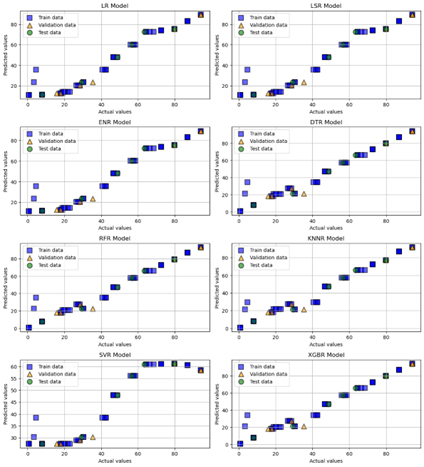
Scatter plots comparing predicted vs. actual OTA concentrations across training, validation, and test datasets for each ML model