Bone Repair and Regeneration Group
Research Areas
Innovative Scaffold
Functionally Graded Scaffolds (FGS)
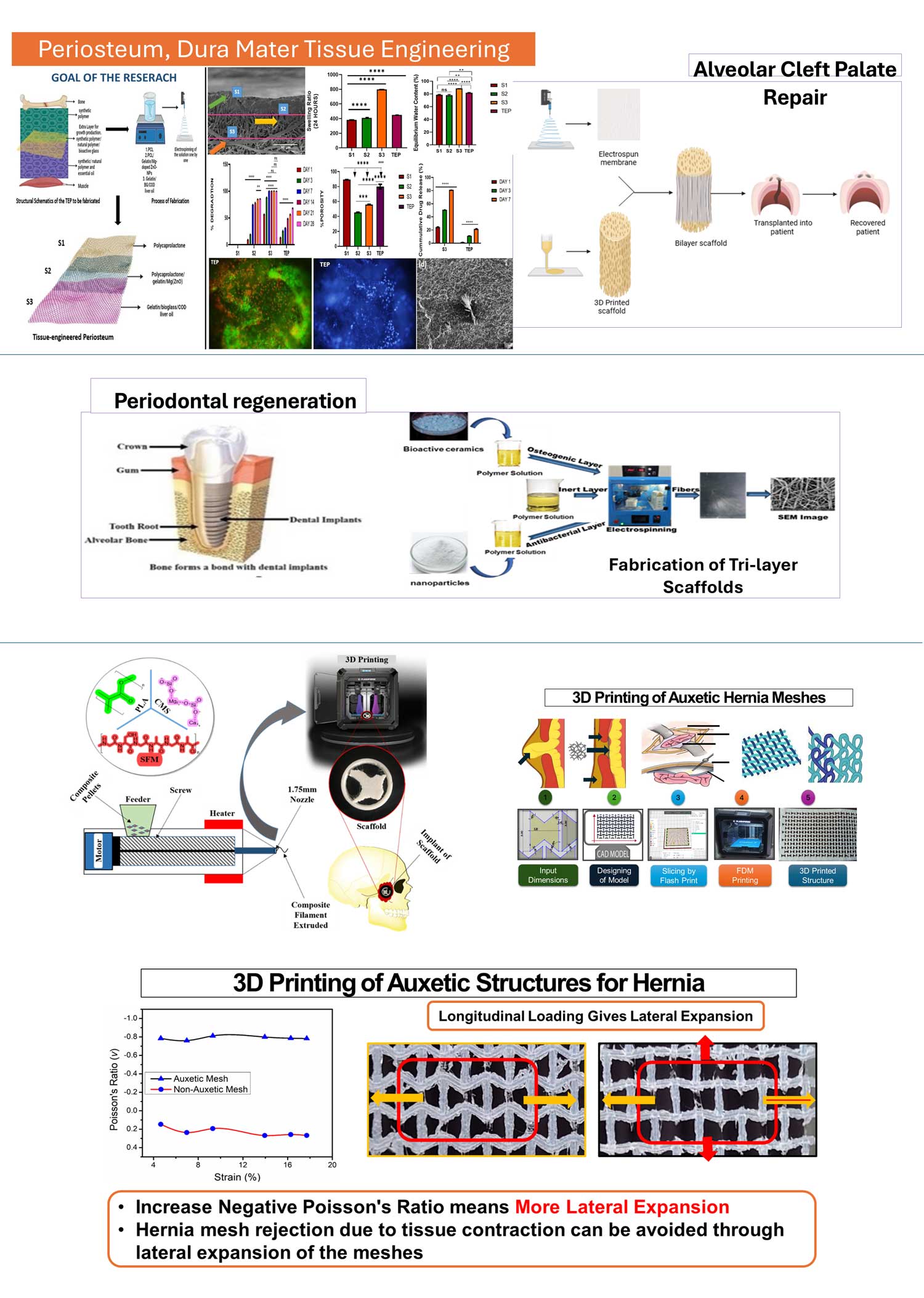
Functionally Graded Scaffolds (FGS) are sophisticated, often multilayered, biomaterials engineered to mimic natural tissue structures and promote the simultaneous regeneration of both hard and soft tissues. Their applications include complex areas like periodontal regeneration, osteochondral repair, periosteum, dura mater tissue engineering, Alveolar Cleft Palate repair, and craniofacial reconstruction.
Addressing the clinical need for integrated bone and soft tissue regeneration in such complex conditions, we are developing an innovative bilayered or trilayered scaffold. This construct features an electrospun layer designed to support soft tissue healing (angiogenesis) and a 3D-printed layer optimized for hard tissue repair (osteogenesis). By enhancing tissue-specific regeneration, vascularization, and defect coverage, this multifunctional platform aims to reduce the number of surgeries required and improve overall clinical outcomes for patients.
3D Printed Biomaterials
The Bone Repair and Regeneration Group leverages cutting-edge 3D printing technologies, including extrusion-based printing, stereolithography, and notably Fused Deposition Modeling (FDM), to fabricate custom-designed scaffolds with intricate architectures. This approach allows for precise control over pore size, interconnectivity, and overall geometry, essential for promoting bone and cartilage regeneration. By integrating patient imaging data (CT/MRI scans), we create patient-specific implants and scaffolds that perfectly match complex defects, offering significant advantages for orthopedic and dental applications compared to standard pre-formed implants.
A key focus involves integrating FDM-based 3D printing for the fabrication of bioactive and biocompatible composite scaffolds. These are created using biomedical polymers combined with functional bioceramics or nanoparticles. This technology enables the potential for on-site or patient-specific printing of customized bone grafts. Utilizing the advanced WELLZOOM filament extruder, we have successfully produced novel composite filaments and subsequently fabricated custom zygomatic bone scaffolds as a specific application example.
Comprehensive material characterization is conducted to ensure the scaffolds’ properties align with the requirements for effective bone regeneration. Furthermore, we perform antibacterial assessments and in vitro degradation studies to evaluate biological safety, material stability, and the synchronization of degradation kinetics with expected host tissue integration over time.
The ultimate goal of this research is to develop highly biocompatible solutions that effectively mimic the architecture of natural bone and provide robust support for the healing of critical-sized defects.
Advanced Bioink Development from Decellularized Umbilical Cord ECM:
We are developing novel bioinks by processing extracellular matrix (ECM) derived from decellularized human umbilical cords. Decellularization removes cellular components while preserving the complex mixture of native proteins and growth factors found in the ECM. This creates a highly biomimetic material that provides crucial biological cues to guide cell attachment, proliferation, and differentiation, ultimately enhancing tissue integration and regeneration. Formulating this ECM into a printable bioink allows us to harness its regenerative potential within precisely engineered 3D structures.
3D Printing of Auxetic Hernia Meshes:
We are exploring the design and fabrication of hernia repair meshes with auxetic properties. Auxetic materials exhibit a negative Poisson's ratio, meaning they become thicker perpendicular to the direction of stretch (unlike conventional materials which thin out). This unique behavior could offer significant clinical benefits for hernia repair, such as improved conformity to the dynamic movements of the abdominal wall, potentially reducing patient discomfort, minimizing mesh wrinkling or buckling, and promoting better load distribution and tissue integration. We utilize 3D printing to create the specific geometric structures required to achieve these auxetic mechanical responses in biocompatible materials.